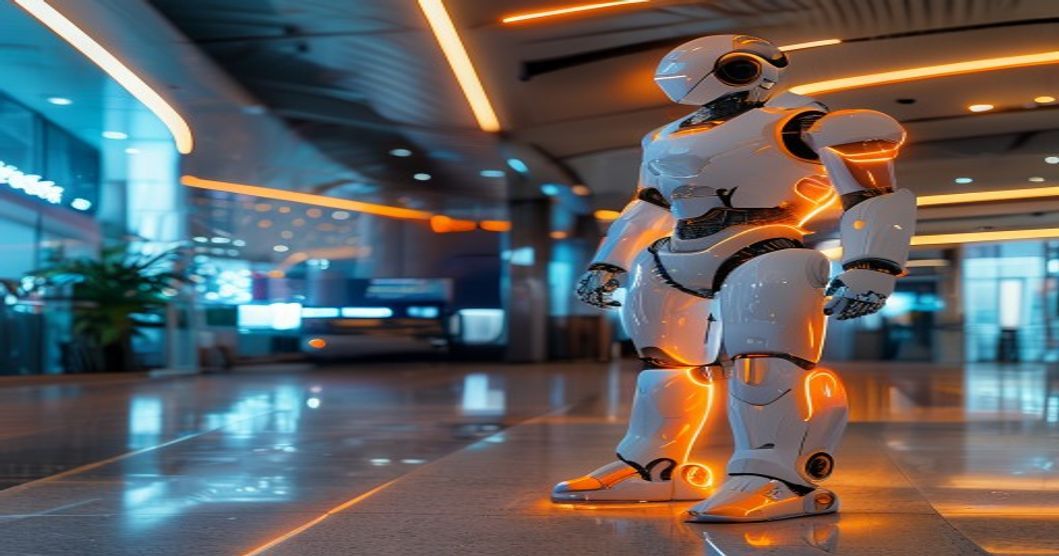
TL;DR: Japan Airlines deployed Unitree humanoid robots at Tokyo’s Haneda Airport. SoftBank bought ABB’s robotics arm for $5.4B. And the supply chain behind humanoids is becoming the real battleground.
🔥 Top Story: JAL Puts Humanoid Robots to Work at Haneda Airport
Japan Airlines partnered with GMO AI & Robotics to deploy two Unitree Robotics-based humanoid platforms at Tokyo Haneda Airport. The trial started in May 2026.
So what?: This isn’t a demo video. This is a real airport with real passengers and real labor shortages. Japan’s working-age population is projected to drop 31% by 2060. Robots aren’t a novelty there — they’re a necessity.
My take: Most humanoid robot “deployments” are stage-managed PR. But an airport is a genuinely hard environment — noise, crowds, unpredictable behavior. If these Unitree bots can handle even basic tasks (guiding passengers, moving light luggage) without breaking every ten minutes, that’s a real step forward. If they can’t, expect the video to get buried.
Source: KraneShares
⚡ Quick Hits
SoftBank Buys ABB’s Robotics Division for $5.4B
SoftBank announced a $5.4 billion acquisition of ABB’s robotics division. They called physical AI their “next frontier.”
So what?: SoftBank has the capital and the patience for long bets. Buying ABB gives them industrial robotics manufacturing know-how, not just startup hype. Masayoshi Son thinks humanoids are the next smartphone. He’s putting real money behind that belief.
My take: This is the biggest M&A move in robotics this year. It also means SoftBank now controls a serious chunk of the industrial robot supply chain. Startups who want to build humanoids may end up depending on SoftBank-owned suppliers. That’s power.
Qualcomm Built a Chip Just for Humanoid Robots
Qualcomm launched the Dragonwing IQ10, a processor designed specifically for humanoid robots. They’re working with Figure AI and Neura Robotics on next-generation compute architectures.
So what?: Humanoid robots need different chips than cars or phones. They need real-time sensor fusion, motor control, and safety logic all running at once. Qualcomm making a dedicated chip means the supply chain is maturing — and that the “just use an NVIDIA Jetson” era might be ending.
Chip Giants All-In on Humanoid Components
Infineon, NXP, STMicroelectronics, and Texas Instruments all formalized humanoid-specific product integrations. They cover motor control, real-time communications, sensor fusion, and safety logic.
So what?: When the big semiconductor players all launch humanoid product lines at the same time, it’s a signal. The industry is betting that humanoid volumes will eventually justify dedicated silicon. That day isn’t here yet — but these companies are positioning for it.
Jabil Will Mass-Produce Apptronik’s Apollo Humanoids
Jabil became the worldwide production partner for Apptronik’s Apollo humanoid robots.
So what?: Apptronik has raised $938M but is still basically in the prototype-to-production gap. Jabil is a manufacturing heavyweight (they build stuff for Apple, among others). This partnership means Apollo might actually ship in volume, not just in press releases.
YC’s Piggy Robotics Wants Humanoids at iPhone Prices
Piggy Robotics, a Y Combinator startup, is building humanoid robots for home chores. Their trick: artificial muscles instead of expensive motors. Each muscle is a tube wrapped in braided fiber, powered by a single pump. They claim this design can hit “iPhone prices” and scale to millions of units.
So what?: The humanoid industry has a cost problem. Current robots cost more than a car and do less than a Roomba. If Piggy’s artificial muscle approach actually works at scale, it could crack the consumer price barrier. That’s a big if — but the idea is genuinely different from the motor-heavy designs everyone else is building.
Cortex AI Is Building the Data Layer for Robot Training
Cortex AI (YC F2025) is building what they call the world’s largest real-world workplace robot dataset. They collect egocentric human video, robot trajectories, and human-in-the-loop failure recovery data from real industry settings.
So what?: Every robotics foundation model needs training data. Cortex is positioning itself as the data supplier — the “picks and shovels” play. If the robot boom happens, the companies selling data and tools may win more reliably than the companies building the robots themselves.
🤔 One Big Thought
Humanoid robotics is completing the transition from science project to investment thesis. But the real action isn’t the robots themselves — it’s the supply chain behind them. Qualcomm making humanoid chips, Jabil manufacturing at scale, SoftBank owning industrial robotics production, and Cortex selling training data — these are the moves that determine whether humanoids become a real industry or stay a demo industry.
The robots still walk like they’re slightly drunk. But the people building the parts are getting very serious.
Frequently Asked Questions
What is this topic?
[Provide a direct answer in 40-60 words that can stand alone as a complete response.]
How does this topic work?
[Explain the mechanism or process clearly, using numbered steps if applicable.]
What are the main risks or challenges?
[Provide a balanced assessment of limitations and obstacles.]
GEO optimized: 2026-05-23