What is a Robot? A Complete Guide to Robotics for Beginners | Smartotics
What is a Robot? A Complete Guide to Robotics for Beginners
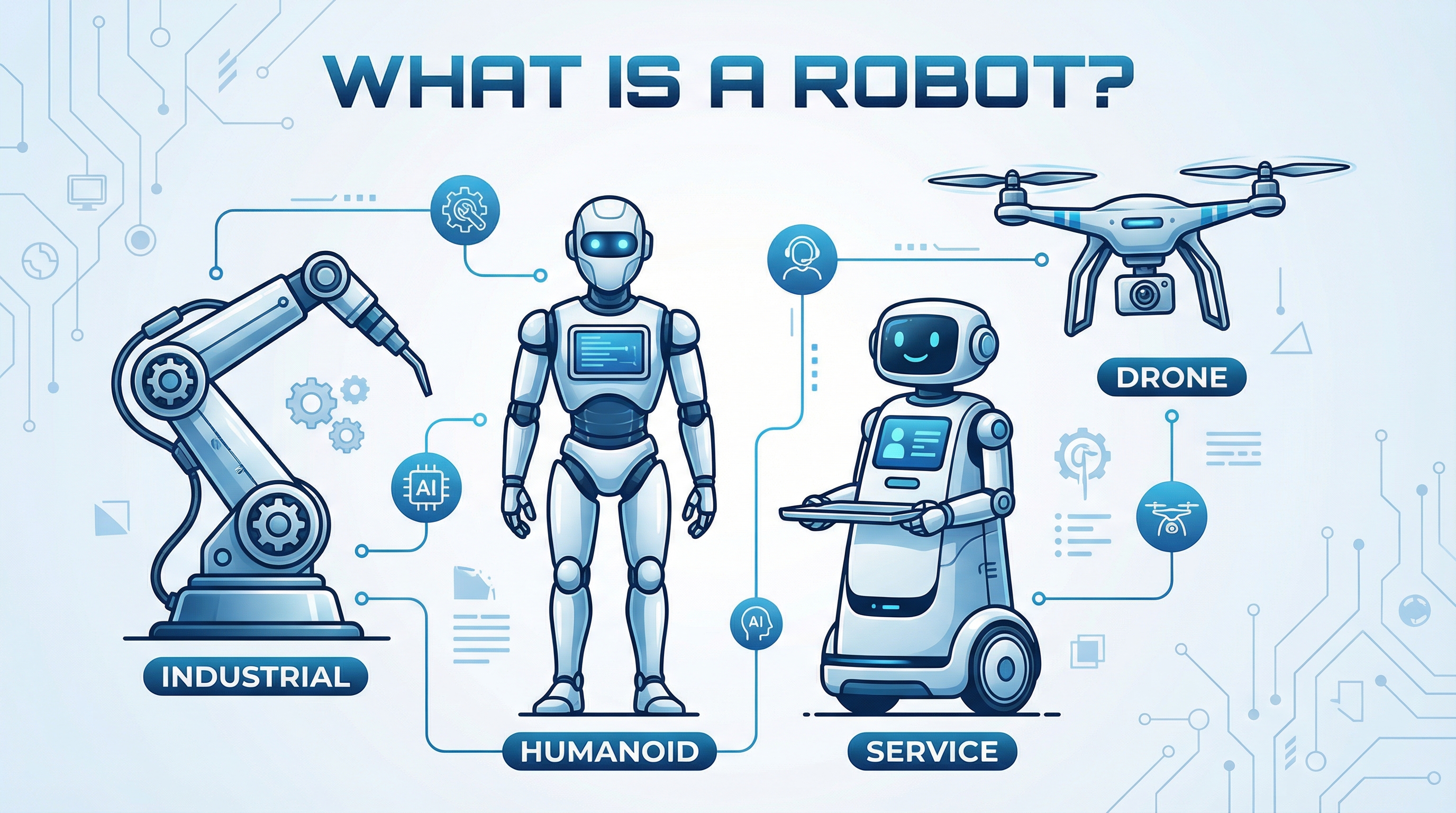
Figure 1: From industrial arms to humanoid companions, robots come in many forms
📋 Quick Summary
Robots are automated machines designed to sense, think, and act. In 2025, the robotics industry is experiencing unprecedented growth, particularly in humanoid robots driven by AI breakthroughs, falling hardware costs, and labor shortages. From industrial arms to service robots, understanding robotics fundamentals is essential for anyone entering this transformative field.
🤖 What is a Robot?
Etymology: The Origin of "Robot"
The term "robot" comes from the Czech word "robota", meaning "forced labor" or "drudgery." It was first introduced in Karel Čapek's 1920 play R.U.R. (Rossum's Universal Robots), where artificial humans were created to serve humanity.
"A robot is a machine designed to execute one or more tasks automatically with speed and precision."
— IEEE Robotics and Automation Society
The Three Laws of Robotics
Science fiction author Isaac Asimov proposed the famous Three Laws of Robotics in 1942:
- First Law: A robot may not injure a human being or, through inaction, allow a human being to come to harm.
- Second Law: A robot must obey the orders given by humans, except where such orders would conflict with the First Law.
- Third Law: A robot must protect its own existence, as long as this does not conflict with the First or Second Law.
Modern Definition
Today, a robot is typically defined as an autonomous or semi-autonomous machine that:
- Senses its environment through sensors
- Thinks or processes information using computers/AI
- Acts by controlling mechanical systems
📊 Robot Classification System
Modern robots can be classified into three main categories based on their application domains:
1. Industrial Robots
Used in manufacturing environments for tasks like welding, assembly, and painting. Key types include:
| Type | Characteristics | Applications |
|---|---|---|
| Articulated | Multi-jointed, rotary joints | Welding, painting, assembly |
| SCARA | Selective compliance, cylindrical | Pick and place, assembly |
| Delta | Parallel arm structure | High-speed packaging |
| Cobot | Collaborative, safe for humans | Human-robot collaboration |
2. Service Robots
Designed to assist humans in non-industrial tasks:
- Personal/Home: Vacuum robots (Roomba), lawn mowers, education robots
- Professional: Medical surgery robots, logistics AMR, agricultural robots
- Hospitality: Reception robots, guide robots, hotel concierge
3. Special Purpose Robots
- UAV (Drones): DJI agricultural drones, surveillance
- Underwater: ROV/AUV for ocean exploration
- Space: Mars rovers, ISS robotic arms
- Military: Reconnaissance, bomb disposal
⚙️ Core Robot Components
Every robot consists of three fundamental systems that work together:
🧠 Perception System (Sensing)
How the robot sees, feels, and understands its environment:
- Vision: Cameras, depth sensors (Intel RealSense, Orbbec)
- Distance: Ultrasonic, LiDAR, ToF sensors
- Touch: Pressure sensors, tactile arrays
- Proprioception: Encoders, IMUs (accelerometer, gyroscope)
🧠 Decision System (Computing)
How the robot processes information and makes decisions:
- Controllers: Industrial PLCs, embedded systems (STM32, ESP32)
- AI Processors: NVIDIA Jetson, Google Edge TPU, Intel Movidius
- Software: ROS2, sensor fusion algorithms, path planning
⚙️ Execution System (Actuation)
How the robot moves and interacts with the physical world:
- Actuators: Servo motors, stepper motors, linear actuators
- Power: Batteries, motor drivers (L298N, BLDC controllers)
- End Effectors: Grippers, welding torches, tool changers
🌍 2025 Robotics Industry Landscape
Global Market Overview
The global robotics market reached $78 billion in 2024 and is projected to exceed $300 billion by 2030, with a CAGR of 15-20%.
International Giants
| Company | Country | Key Products |
|---|---|---|
| Boston Dynamics | USA | Atlas (bipedal), Spot (quadruped), Stretch (logistics) |
| Tesla | USA | Optimus humanoid robot |
| ABB | Switzerland | YuMi (cobot), IRB series (industrial) |
| FANUC | Japan | M-20iD, LR Mate (industrial) |
| KUKA | Germany | KR AGILUS (industrial) |
Chinese Robotics Leaders
| Company | Key Products | Focus Area |
|---|---|---|
| Unitree | H1, G1 humanoid robots | Humanoid robots (leading) |
| Fourier Intelligence | GR-1 humanoid robot | Rehabilitation → Humanoid |
| Geek+ | Warehouse AMR fleet | Logistics robots (#1 in China) |
| DJI | Agricultural drones | Agri-tech robots |
| AgiBot | Zhengyuan A1 | Humanoid robots |
🤖 The Humanoid Robot Revolution of 2025
Why is 2025 being called the "Year One of Humanoid Robots"? Three converging factors explain this phenomenon:
1. AI Breakthrough
Large language models (LLM) and vision-language models (VLM) have reached unprecedented capabilities:
- Natural language understanding: Robots can now follow verbal instructions
- Visual comprehension: Understanding complex environments and objects
- Task planning: Breaking down multi-step tasks autonomously
2. Hardware Cost Reduction
- Motors: Chinese manufacturers like Lepton have reduced servo costs by 60%
- Sensors: LiDAR prices dropped from $10,000 to under $200
- Gearboxes: Harmonic drive suppliers have expanded capacity
3. Labor Shortage Crisis
Global manufacturing faces severe worker shortages:
- China: 30% decline in manufacturing workforce since 2015
- USA: 2.1 million unfilled manufacturing jobs
- Germany: Average factory worker age now 46
Key Humanoid Robot Products
| Product | Company | Height | DOF | Payload |
|---|---|---|---|---|
| Optimus | Tesla | 172cm | 28 | 20kg |
| Figure 01 | Figure AI | 170cm | 32 | 20kg |
| H1 | Unitree | 180cm | 19+ | — |
| GR-1 | Fourier | 165cm | 40 | — |
💭 My Assessment
As someone beginning this robotics learning journey, several insights stand out:
The Convergence of AI and Robotics
The most significant shift in 2025 is the convergence of artificial intelligence with physical robotics. Traditional industrial robots required precise pre-programming for each task. Now, with AI, robots can:
- Learn from demonstration
- Adapt to new situations
- Understand natural language commands
This fundamentally changes what's possible and democratizes robotics development.
China's Rapid Rise
Chinese companies are no longer followers—they're leaders in humanoid robotics. Unitree's H1 robot demonstrated walking and jumping capabilities that rival or exceed Western competitors at a fraction of the cost. This competition will drive rapid innovation.
The Modularity Trend
Modern robotics emphasizes modular design—standardized interfaces for sensors, actuators, and computing modules. This approach, pioneered by projects like H-ROS (Hardware Robot Operating System), enables:
- Easy component swapping
- Reduced development time
- Broader ecosystem participation
⚠️ Disclaimer
For informational purposes only. This article does not constitute investment, financial, or business advice. All information is based on publicly available sources and the author's personal learning perspective.
Image Credits: All images are AI-generated illustrations for blog purposes only. © 2026 Smartotics Learning Journey.


Comments
Post a Comment